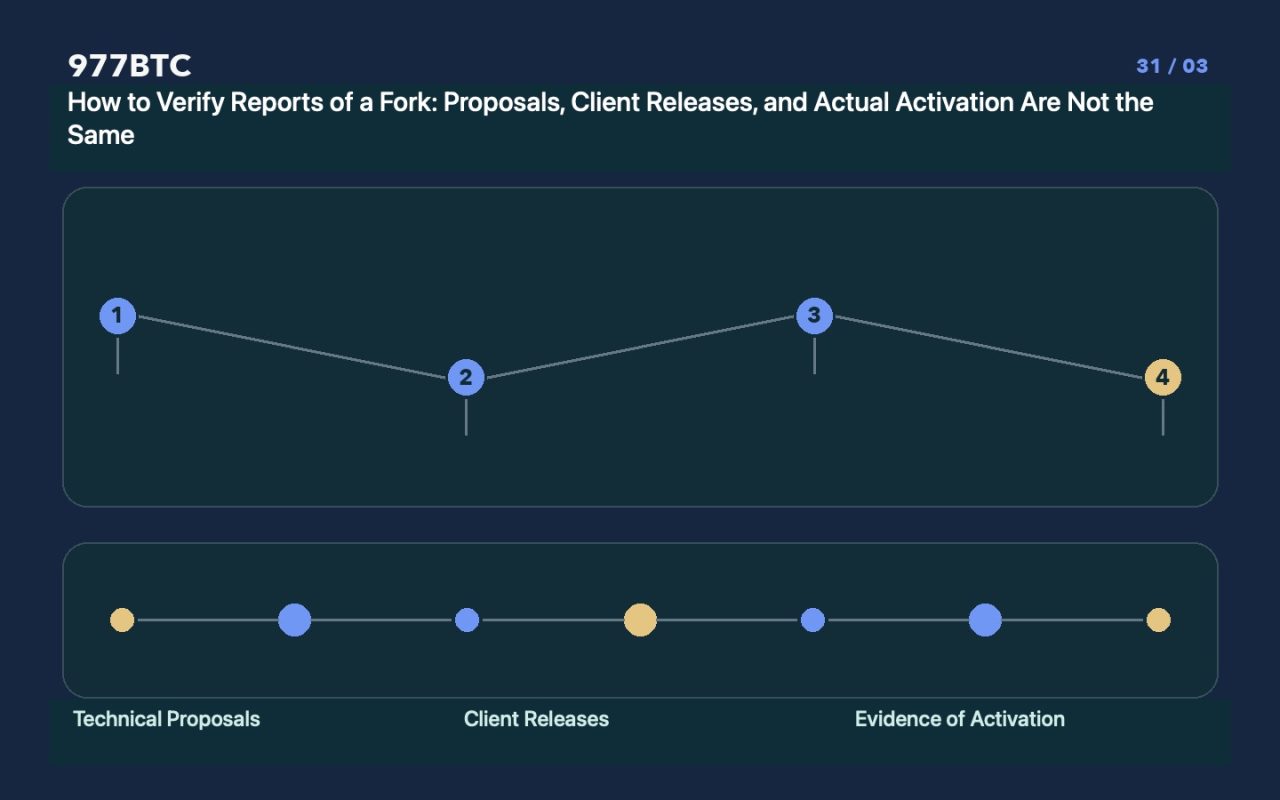
First, identify the specific type of fork mentioned in the report.
The term "fork" can refer to protocol upgrades, competing chains, or temporary chain splits—meanings vary by context. When you encounter a claim of an "impending fork," note the network, the name of the proposal, the nature of the changes, and the date of the report. Then, determine whether it is merely an idea, an implementation, or an activation event. This article serves as a guide for interpreting such news; it does not report on any specific ongoing fork, nor does it offer advice on the timing of transactions.
Acceptance of a Proposal Does Not Equal Network Adoption
Technical proposal repositories document discussions and specifications. The assignment of a proposal number or a change in its status is not, by itself, proof that all users have adopted it. You must verify the implementation, the client versions, and the activation criteria. Statements of community support are not a substitute for verifiable network outcomes. If a news report cites a single developer, ensure the context is preserved—do not reframe it as a definitive decision made by the entire network.
Client Releases Are Distinct from Actual Operation
Software release notes may indicate that a feature has been implemented, but users and operators may not have upgraded yet. To determine whether activation has occurred, look at the specific mechanisms, network conditions, block heights, or time-based criteria. Do not conflate mainnet with testnet, and distinguish between release candidates and stable versions. Download links should always come from official sources; do not install software simply because a news page provides an "upgrade wallet" button.
Reconstruct the timeline using an evidence table.
Each entry should include the original timestamp, network, phase, responsible party, and supporting evidence. For example, a sequence might begin with a proposal discussion, followed by a test implementation, with activation requiring separate verification. This order reflects a common verification approach, though not all protocols follow the exact same process. If dates are revised, retain the original forecast alongside the updated information—do not silently alter the original report to make it appear as though an accurate prediction was made from the start.
Verify announcements regarding assets and platforms separately.
Protocol events do not automatically mean that users will receive new assets, nor do they guarantee that a platform will support deposits, trading, or withdrawals. Check the platform’s specific details regarding assets, networks, and timeframes to determine if any user action is required. Be especially wary of websites that request your private keys in order to "claim" forked coins; importing your keys into a wallet to claim obscure assets could expose you to risks that far outweigh any potential gains.
Conclusions in reports should account for uncertainty.
Distinguish between established facts, planned events, and unconfirmed rumors; cite original proposals and official release announcements. If information cannot be verified, label it as "pending confirmation." Do not infer that a technical event has occurred based solely on market price movements. Forks involve complex issues such as compatibility, replay protection, and service support. This text does not guarantee the safety of any specific approach, nor does it constitute investment or operational advice.