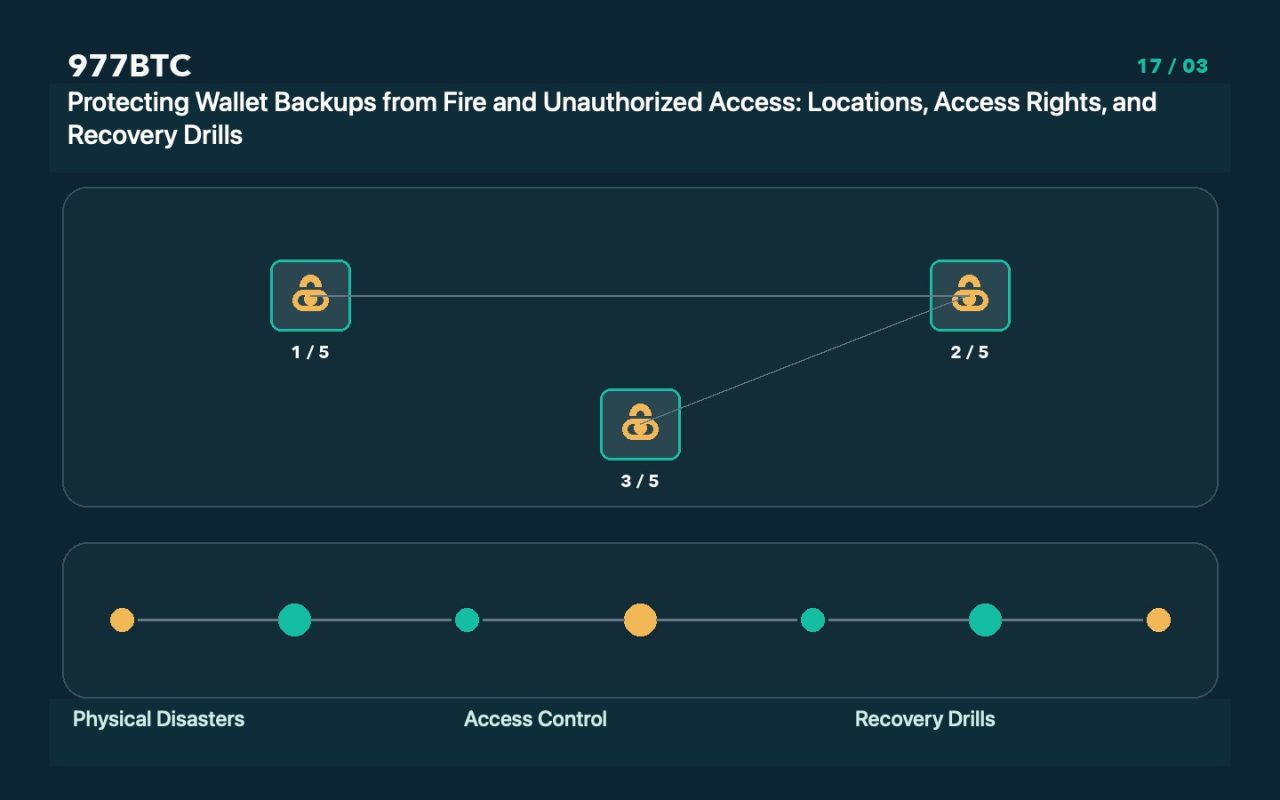
Begin by listing realistic loss scenarios.
Wallet backups must be protected against both loss and unauthorized access. Events such as fires, floods, moving house, accidental disposal by household members, or property disputes could potentially affect both your primary device and your backups simultaneously. Identify events that could destroy all copies at once, then consider geographic separation. Storing your device, recovery phrase, and passphrase together in one package—while convenient—creates a single point of failure where one incident could compromise every recovery path.
Material durability is no substitute for confidentiality.
Heat-resistant or corrosion-resistant media only mitigate specific physical risks; they do not prevent someone who knows what they are looking at from reading the data, nor do they guarantee that the information was recorded correctly. When purchasing backup supplies, verify the source, instructions, and operational limits—and be skeptical of claims promising "permanent security." Taking photos, scanning to the cloud, or printing via a networked device can introduce the risk of digital leaks; carefully evaluate the specific threats associated with any digital copies you choose to create.
Ensure that access arrangements are practical and executable.
Once backups are stored in separate locations, clearly define who has access, under what conditions they may retrieve the items, and how these arrangements should be updated in the event of a move or a change in personal relationships. Do not leave third parties to guess your recovery procedures based on an incomplete note. Matters concerning inheritance or legal arrangements require professional local advice. While a security plan may contain operational instructions and contact information, you should avoid keeping all secrets and access instructions in the same, easily accessible location.
Recovery drills should not increase your exposure.
The purpose of a drill is to verify that records are legible, procedures are understandable, and equipment is compatible. Never enter your actual mnemonic phrase into a web-based interface—even for the sake of convenience. Use officially supported security verification methods and always cross-check the recovered addresses against your expected ones. Practice the process first using a "test" wallet that holds no real assets to minimize the risk of errors. When testing recovery for actual assets, carefully consider the trustworthiness of your devices and the security of your operating environment; do not perform such tests more frequently than necessary.
Increasing the number of copies also expands your attack surface.
While multiple copies improve availability, they also increase the number of locations where a leak could occur. If you choose to split your secret or use a multi-signature setup, ensure you fully understand the associated recovery thresholds, standards, and compatibility requirements. Arbitrarily splitting a mnemonic phrase into segments can often result in a fragile security scheme. Furthermore, a complex design understood only by you may fail during an emergency. Do not mistake technical jargon for a guarantee of security; always verify that you—and any authorized individuals—can execute the procedures correctly.
How to conduct periodic checks without exposing your secrets.
Regularly check the accessibility of storage locations, the integrity of sealed containers, the condition of physical materials, and the accuracy of contact information—there is no need to transcribe the full secret during these routine checks. Update your procedures whenever you move, replace hardware, or experience changes in your personal or family circumstances; maintain a version of your records that does not contain the actual secrets. This document provides a framework for analyzing risks; it does not guarantee the absolute security of any specific storage medium, custodian, or recovery scheme. Ultimately, you should evaluate these options based on your own individual circumstances.