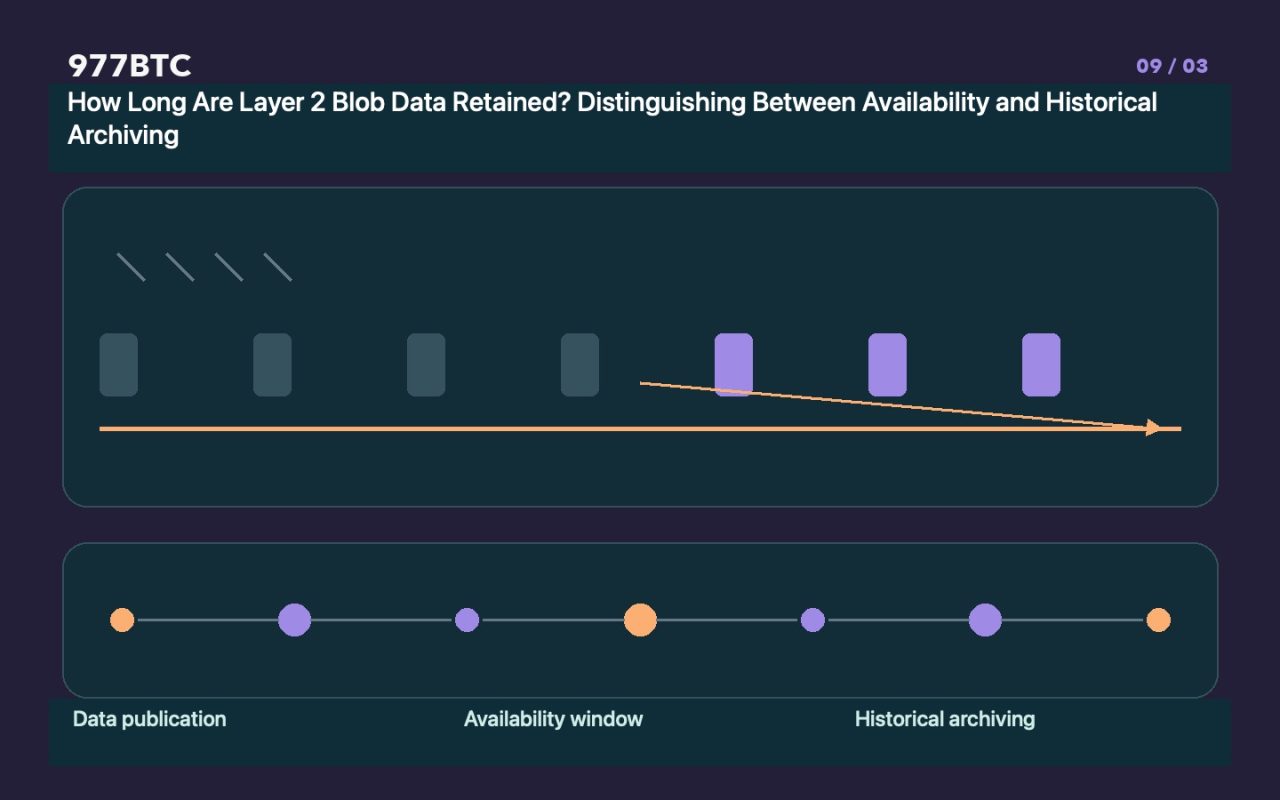
First, Distinguish Between Execution Data and Blob Data
Some Layer 2 networks use Blobs to carry data published to Ethereum. The design goal of Blobs includes data availability—but this does not mean every standard node retains all historical content permanently. Just because a block explorer displays a specific submission record, it does not follow that a given node still holds the full payload. When researching a Layer 2 chain, it is essential to clarify the submission method, the verification process, and who is responsible for archiving historical data.
Short-term Availability Is Not the Same as Permanent Backup
Protocols and client software establish specific rules for the service and retention of Blob data. These parameters may change through upgrades, so always consult the current specifications. Do not treat a retention duration mentioned in an older article as a permanent guarantee. While a cryptographic commitment to historical data may remain queryable, the commitment itself, the actual data, and the available archiving services are distinct concepts; possessing a hash does not guarantee the ability to reconstruct the full content from that hash.
Why Should Ordinary Users Care?
Wallet balances are typically provided by applications or nodes, so users rarely need to download Blob data directly. However, in scenarios such as operator downtime, the need to independently reconstruct the state, or the resolution of disputes, the paths for accessing this data become critical. The exit capability of a Layer 2 (L2) network also depends on its bridges, proof systems, and upgrade governance; one should not assume that all failures are automatically resolved by the mainnet simply because the network "uses Ethereum data."
An example of a historical query
Suppose a researcher needs to verify a batch of L2 transactions from several months ago. They must first locate the relevant L2 blocks and the corresponding batches submitted to the mainnet, then determine the data format and identify an archival source that still provides the payload. If an ordinary endpoint cannot retrieve old data, one cannot immediately conclude that the original transactions never existed. It is necessary to cross-reference the endpoint’s service scope, batch references, and other independent sources, while documenting any steps that remain unreproducible.
Methods for evaluating archival service providers
Examine the provider’s data retention scope, integrity verification mechanisms, download formats, rate limits, payment terms, and history of service interruptions. Ideally, verify that the downloaded content aligns with the provider’s stated commitments, and avoid relying solely on a single commercial API. "Permanent preservation" requires a clearly defined responsible entity and a verifiable mechanism; marketing slogans are not equivalent to long-term, enforceable service obligations.
Documenting sources for research and data analysis
Record the L1 and L2 network identifiers, batch and block hashes, protocol versions, query timestamps, and the archival source addresses. When citing data, specify whether the download is complete, whether there are any gaps, and whether the data has been independently verified. This text explains the data lifecycle but makes no guarantees regarding the security of any specific L2 system; protocol upgrades, archival services, and exit conditions should always be re-verified before actual use.