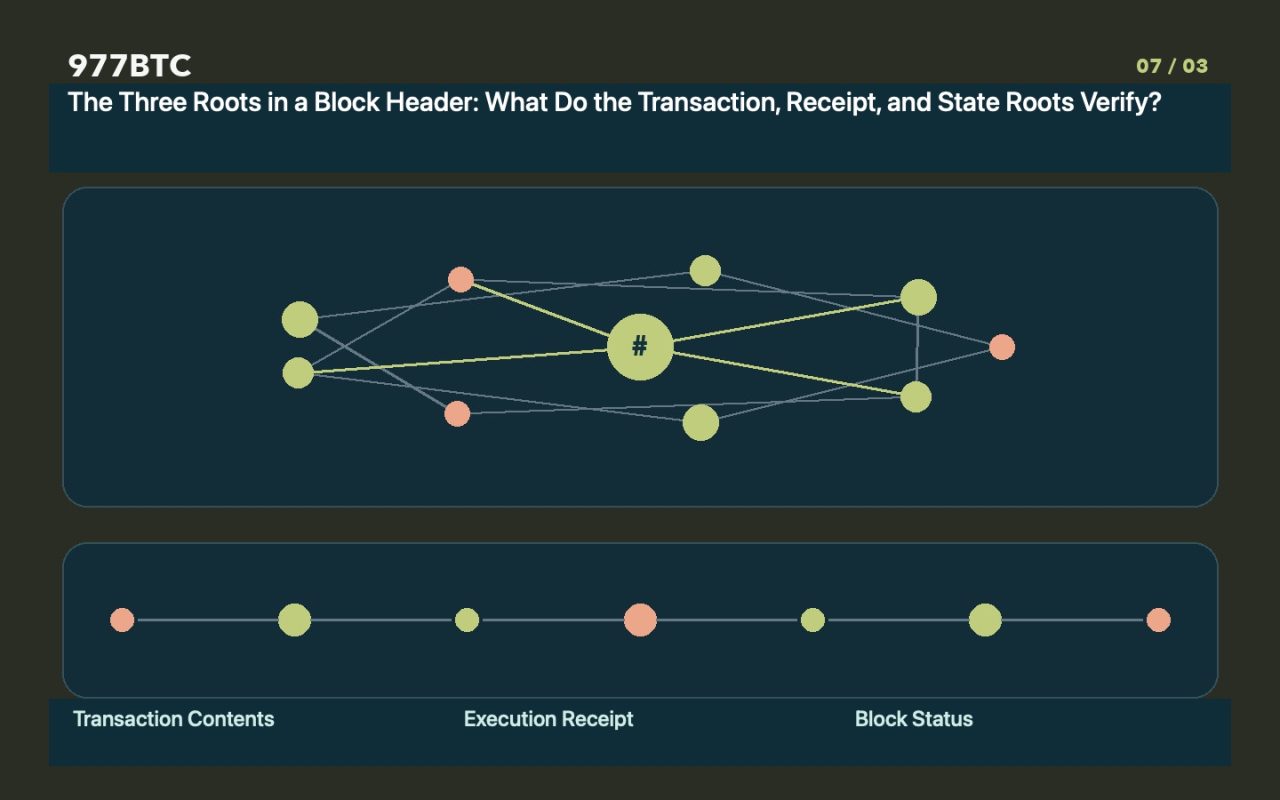
First, clearly define what needs to be proven.
When examining a block, common questions include: Was a specific transaction included? What was the execution result? What was the state of a particular account at a given block? These are distinct questions that require different data and proofs. While the root hashes in a block header provide commitments to the corresponding data structures, a root hash is not a human-readable list of accounts, nor does it explain why a transaction led to a specific business outcome.
The Transaction Root Corresponds to the Set of Transactions
The transaction root relates to the sequence of transactions organized within a block. Verifying the inclusion of a specific transaction requires knowledge of the network, the block header, and the relevant proof structure. Inclusion does not imply successful execution, nor does it mean that a receiving platform has credited a user’s account. A block explorer link merely provides an entry point for queries; when formal verification is required, one must be clear about what is being trusted—the node, the block explorer, or the verified block header itself.
The Receipt Root Corresponds to Execution Results
Receipts typically contain information such as execution status, cumulative gas usage, and logs. The receipt root serves as a commitment to these execution results—not to the account balances held on a platform. While applications may use logs to identify activity, one must consider the contract that emitted the log, the decoded parameters, and the transaction status collectively. Seeing an event labeled "Transfer" does not negate the need to verify the authenticity of the token contract and the actual outcome of the execution.
The state root describes the state of a specific block.
A state root corresponds to a snapshot of the state, which may encompass account balances, nonces, code, and the associated storage structure. A proof is tied to a specific block; a proof from yesterday cannot be applied to the state today. Furthermore, the validity of a proof for a specific storage slot does not imply the absence of risks related to tokenomics, governance permissions, or external oracles. The scope of a technical commitment should be defined more precisely than the broad claim of being "fully verifiable on-chain" often found in marketing materials.
An example of cross-field verification
Suppose a user wishes to verify a smart contract invocation. First, identify the block in which the transaction was included; next, examine the transaction receipt to confirm success and review event parameters; finally, query the relevant account or contract state based on the specific inquiry. If a block explorer and an application display different information, verify whether they are referencing different block heights or different networks—do not immediately assume that one party is acting fraudulently. This example illustrates the hierarchy of evidence and does not constitute an audit conclusion for any given smart contract.
Preserving the context of a proof
Retain the chain identifier, block height and hash, root hash type, query method, proof data, and tool version. If a third-party decoding service is used, note its role and any potential caching delays. Finality and chain reorganizations may still affect the status of a selected block. Verifying a data proof addresses only specific technical questions; it does not validate the service entity, asset reserves, or the future redeemability of assets.