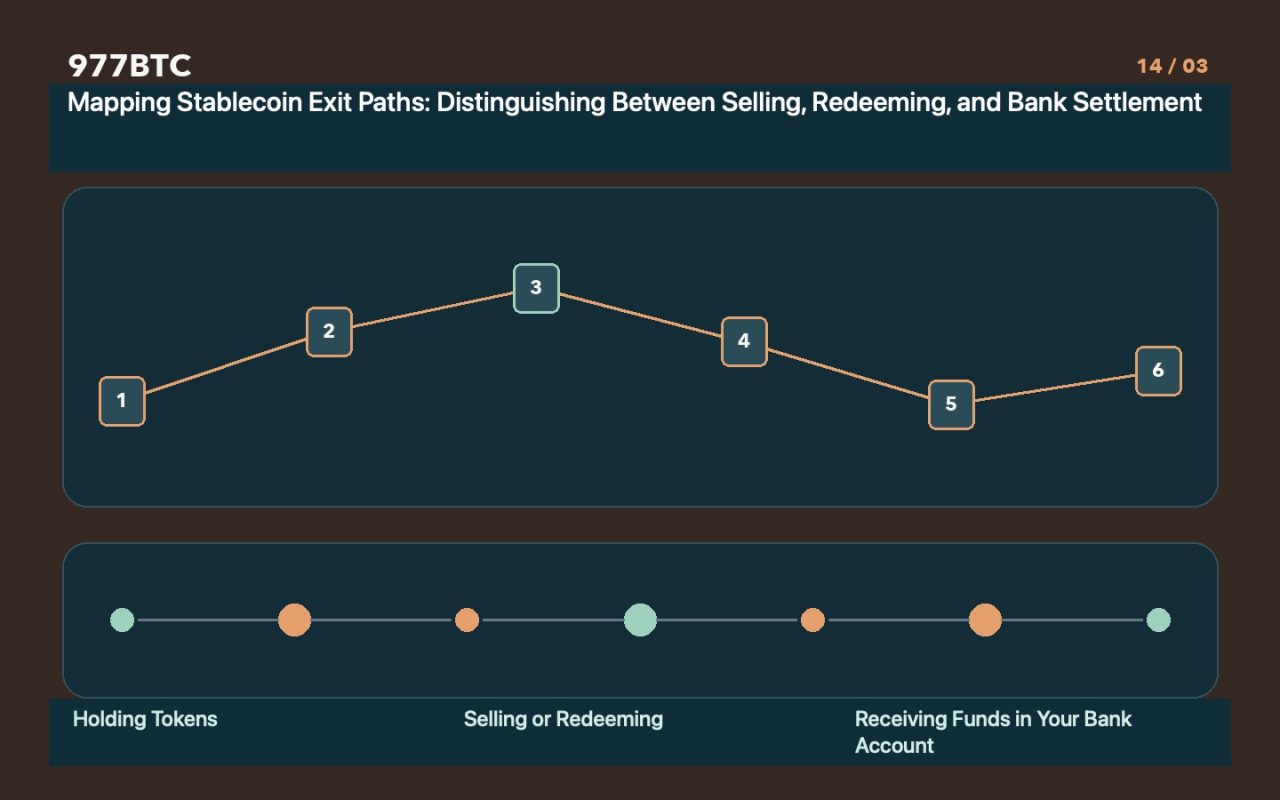
Different Paths Under the Same Label of "Exit"
Selling stablecoins to a counterparty, exchanging them for fiat currency on an exchange, and requesting redemption from the issuer are distinct arrangements. Each path carries its own specific eligibility requirements, limits, fees, and responsible parties. Holding a token does not automatically grant one the status of an eligible redemption client for the issuer; always review the issuer’s terms first to determine if an exit route exists that aligns with your personal profile and jurisdictional status.
Map Out Every Financial Node
Begin with your personal wallet and trace the flow: the network, the receiving platform, the exchange process, fiat balances, bank accounts, and the expected documentation. For every step (represented by an arrow), note which entity is handling the transaction and whom to contact in the event of a failure. Do not assume compatibility simply because both ends support a stablecoin with the same name—the underlying network might be incompatible, or the token could be a "wrapped" version. Exiting via bridged assets may also depend on the solvency and liquidity of the bridge itself.
Categorizing Price Deviations and Redemption Conditions
Secondary market prices are influenced by order book depth, specific trading pairs, and overall market conditions, whereas issuer redemption rules are governed by contractual agreements. In the event of a price deviation, one cannot automatically assume that every holder is entitled to an immediate redemption at face value. Record the timing of quotes, available quantities, and eligibility restrictions. Discrepancies between market quotes and advertised reference prices cannot always be resolved through a single, direct action.
The receipt of funds into a bank account serves as the final layer of verification.
A fiat balance on a platform is not the same as funds having actually cleared into a bank account. You must account for the payer, requirements regarding the recipient’s name, processing times, bank fees, and potential compliance reviews. Never use third-party accounts or attempt to conceal the true source of funds in an effort to expedite receipt. Proof of receipt should be traceable to both the exchange records and on-chain transfers; be prepared to explain the origin of assets rather than relying solely on a screenshot of a balance.
How should testing and contingency plans be structured?
Once eligibility, network, and fees have been confirmed, conduct a small-scale test—at an acceptable cost—to verify the transaction path at a specific point in time. Establish clear "stop" criteria, such as ambiguous settlement status, service interruptions, changes in contracting entities, or costs that significantly exceed expectations. Alternative paths must also be independently verified; do not treat unknown third-party payment processors or high-discount OTC quotes as risk-free alternatives.
What fields should be included in a transaction path log?
At a minimum, record the issuing entity, token contract, network, receiving service, exchange method, fiat currency, final bank destination, source of fees, and the date of inquiry. Mark any unconfirmed steps as "unknown" and do not proceed with those segments. Stablecoins carry inherent risks, including de-pegging, custodial issues, and liquidity concerns. This document does not guarantee redemption at face value, nor does it supersede the existing terms and conditions set forth by issuers, platforms, or banks.