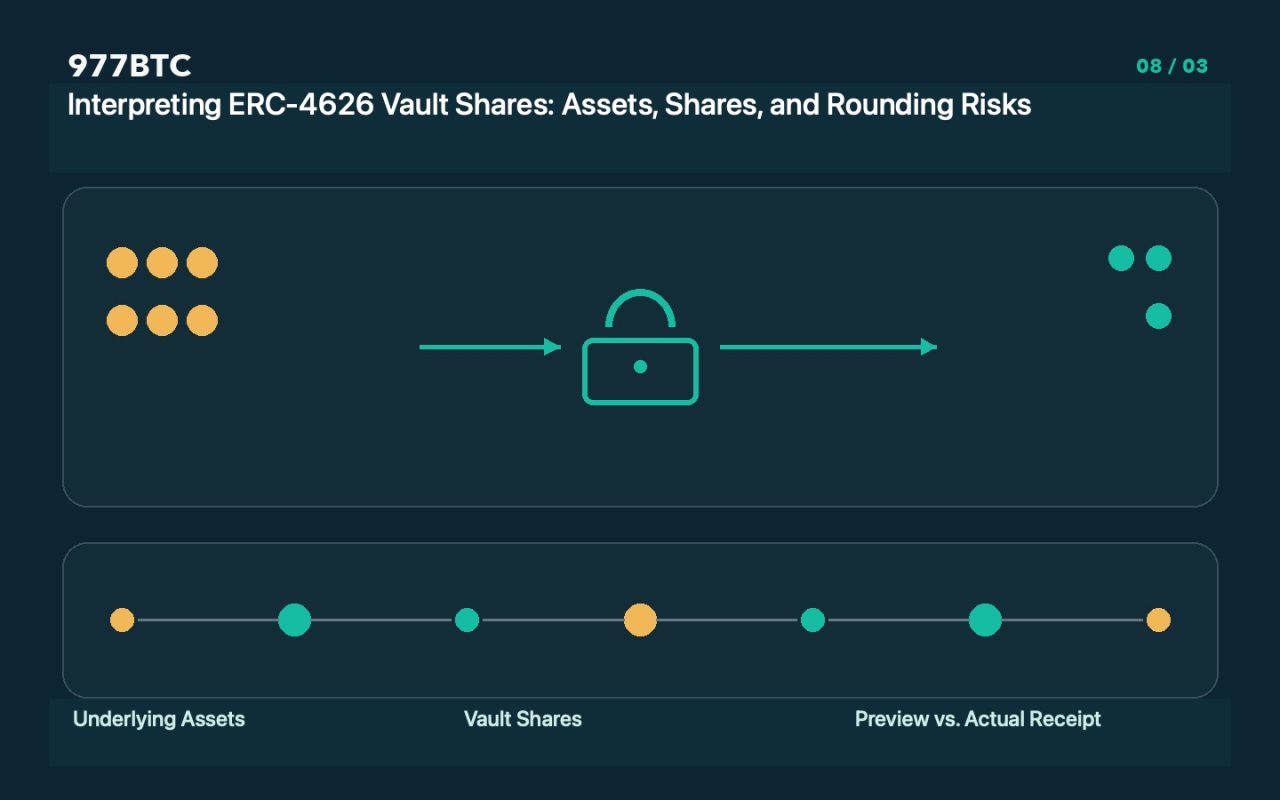
Asset Balances and Shares Are Not the Same Unit
ERC-4626 provides a standardized interface for tokenized vaults, typically describing deposits and withdrawals in terms of "assets" and "shares." Depositing a certain quantity of an underlying asset does not necessarily result in receiving an equivalent number of shares; the ratio may shift based on the vault's state. When reviewing data, always verify the token contract referenced by the "asset" field, the decimal precision of the share tokens, and the network—do not assume that similar symbols or displayed values represent the same asset.
The Purpose of Conversion and Preview Fields
The standard includes interfaces for converting between assets and shares, previewing deposits and redemptions, and checking maximum limits. These tools explain quantitative relationships based on the current state, but they do not replace actual transaction execution, nor do they guarantee a final outcome. Different methods have specific semantics regarding how fees and constraints are handled; integrators should consult the original specification rather than treating every returned figure as a "guaranteed" amount.
How Rounding Direction Affects Small-Scale Users
Integer arithmetic requires rounding, and the direction of this rounding affects the units received during deposits or redemptions. For small transaction amounts, the impact of rounding can be more significant. Given the proportional nature of these systems, a very small deposit might be insufficient to secure a meaningful share; furthermore, the interface may display rounded figures, which can mask the actual underlying amounts. Do not use real funds to test the extreme behaviors of an unfamiliar vault.
Look beyond the displayed yields to consider the risks.
Interface compatibility does not guarantee the safety of a strategy. You should investigate who has the authority to upgrade contracts, pause withdrawals, adjust fees, or alter the underlying strategy. Determine whether assets are deployed into other protocols and whether there is a waiting period for exits. Quoted annualized figures are often based on historical data and do not guarantee future performance or the protection of your principal. Additionally, the total value of assets in a vault does not imply that every holder can exit immediately at the same proportional rate.
Compare the preview against the actual transaction receipt.
Before proceeding, record the network, asset contract, vault address, preview block, input amount, expected shares, fees, and any withdrawal restrictions. After execution, verify the transaction receipt and the actual change in your assets. Before signing any transaction, check the authorized recipient and the spending limit. If the actual outcome differs significantly from what was expected, cease further authorizations and investigate the cause; do not attempt to "verify" your assumptions by repeatedly increasing the transaction amount.
Review the scope and limitations of the conclusions presented in the vault documentation.
Audit reports, open-source code, and standard interfaces provide different types of information and cannot substitute for one another. Audit reports are limited by time, version, and scope; conclusions from an earlier version may no longer apply after an upgrade. This text explains methods for measurement and verification; it does not endorse any specific vault, nor should preview results be interpreted as a guarantee of returns. Always verify whether your jurisdiction and the platform’s terms of service permit your participation.