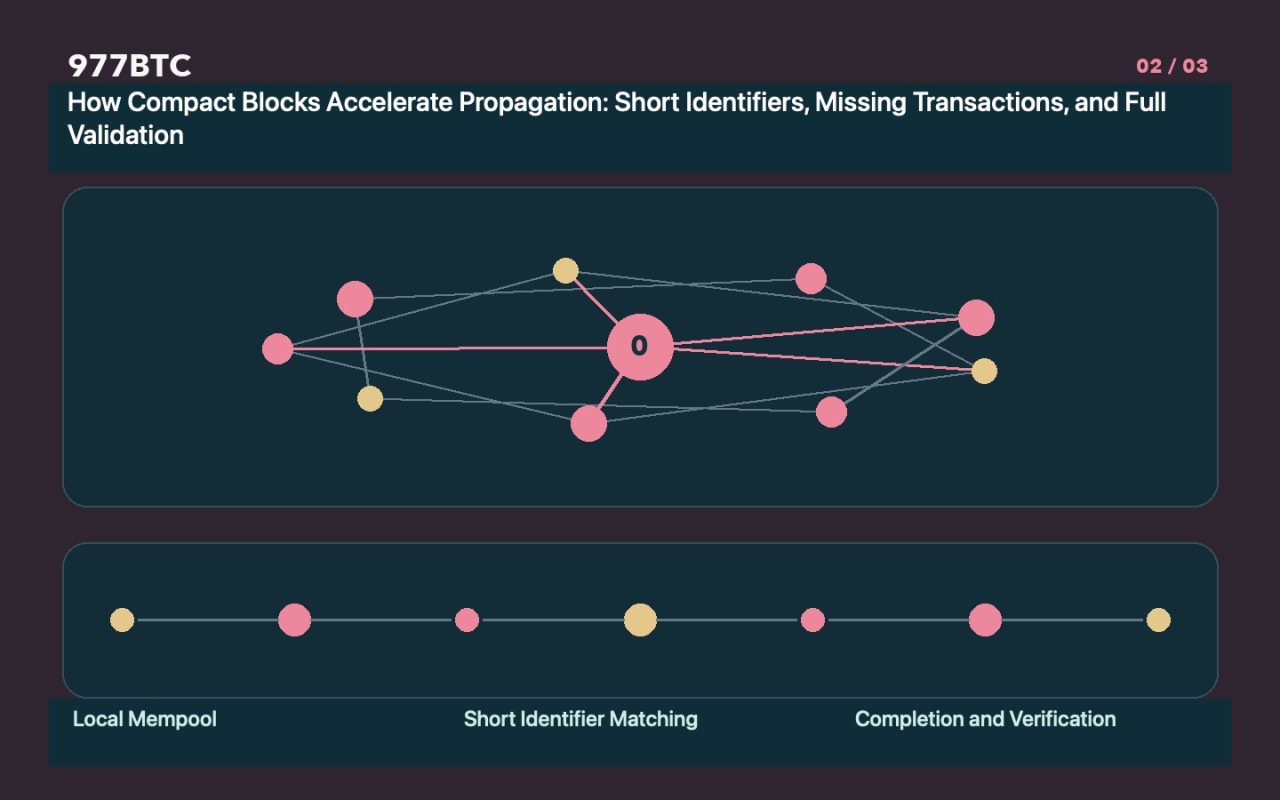
Slow propagation and slow validation are two different issues.
When a new block appears, other nodes must obtain its transactions and validate the block. If a node’s mempool already contains most of these transactions, downloading the entire set again wastes bandwidth. Compact blocks leverage this overlap by sending only the information needed for reconstruction. This optimization of data propagation does not allow nodes to skip transaction checks, nor does it guarantee that this method will always be faster than a full data transfer.
How Short Identifiers Facilitate Reconstruction
As described in BIP152, a compact block consists of a block header, a nonce (used to generate short identifiers), pre-filled transactions, and short identifiers for the remaining transactions. The receiving node attempts to match these against its local mempool to reconstruct the block in the correct order. A short identifier is neither a full transaction identifier nor a proof of balance; it is a compact clue designed specifically for the propagation process and cannot be used independently to audit the authenticity of a transaction.
What Happens When Transactions Are Missing Locally?
If a receiving node is missing transactions, encounters ambiguity during matching, or fails to reconstruct the block, it will request the missing components from its peers. Factors such as network policy, differences in mempool content, or a node’s recent startup can all affect the "hit rate" (the likelihood that a transaction is already present locally). When observing a log entry indicating a "request for missing transactions," one should not immediately conclude that the peer is acting maliciously or that the software is malfunctioning. Instead, the situation should be evaluated by considering the proportion of missing data, the quality of the network connection, and whether full verification is successfully completed afterward.
An example of the reconstruction process
Suppose a new block contains multiple transactions. If a node has already encountered most of these in its mempool, it can populate the known positions upon receiving a "compact block" and then download only the remaining transactions. If a node has just finished synchronization and its mempool is relatively empty, the cost of retrieving the missing data will be higher. This example is intended solely to illustrate the mechanism; the proportions shown should not be taken as representative of real-world network statistics, nor should they be used to draw conclusions about propagation latency from mining pools.
What should node operators monitor?
Operators should track software versions, peer connection types, block reception times, reconstruction failures, and instances where missing data had to be retrieved—comparing performance during normal operation against periods following a restart. Note that log timestamps can be affected by the local system clock and network conditions; therefore, data from a single device cannot be considered representative of the entire network. When troubleshooting, first consult official release notes and check network connectivity before examining local resources. Avoid disabling critical verification steps or adopting unverified configurations in a pursuit of higher speed.
How to avoid misunderstandings when reading related news
When encountering headlines such as "block compression" or "sub-second synchronization," verify whether the report refers to block propagation, historical synchronization, or consensus finality. Compact blocks do not reduce the verification requirements for the transactions themselves, nor do they render confirmed transactions entirely immune to reorganization. To properly evaluate an author's conclusions, one must consider the specific BIP versions, software implementations, and test environments used; performance figures presented without this context should not be directly compared.