Clarifying the Term "Coinbase Transaction" vs. the Exchange Platform
In Bitcoin, the first special transaction in every block is called a "coinbase transaction"—it is entirely unrelated to the cryptocurrency exchange of the same name. Unlike standard transactions, it does not reference existing inputs; instead, it allows for the collection of the block subsidy and the transaction fees from that block, in accordance with consensus rules. When a block explorer displays "mining rewards," one must verify the specific network, block height, and the actual output; a balance shown in a mining pool account should not be conflated with an on-chain reward that is already available to spend.
What Does the Maturity Period Restrict?
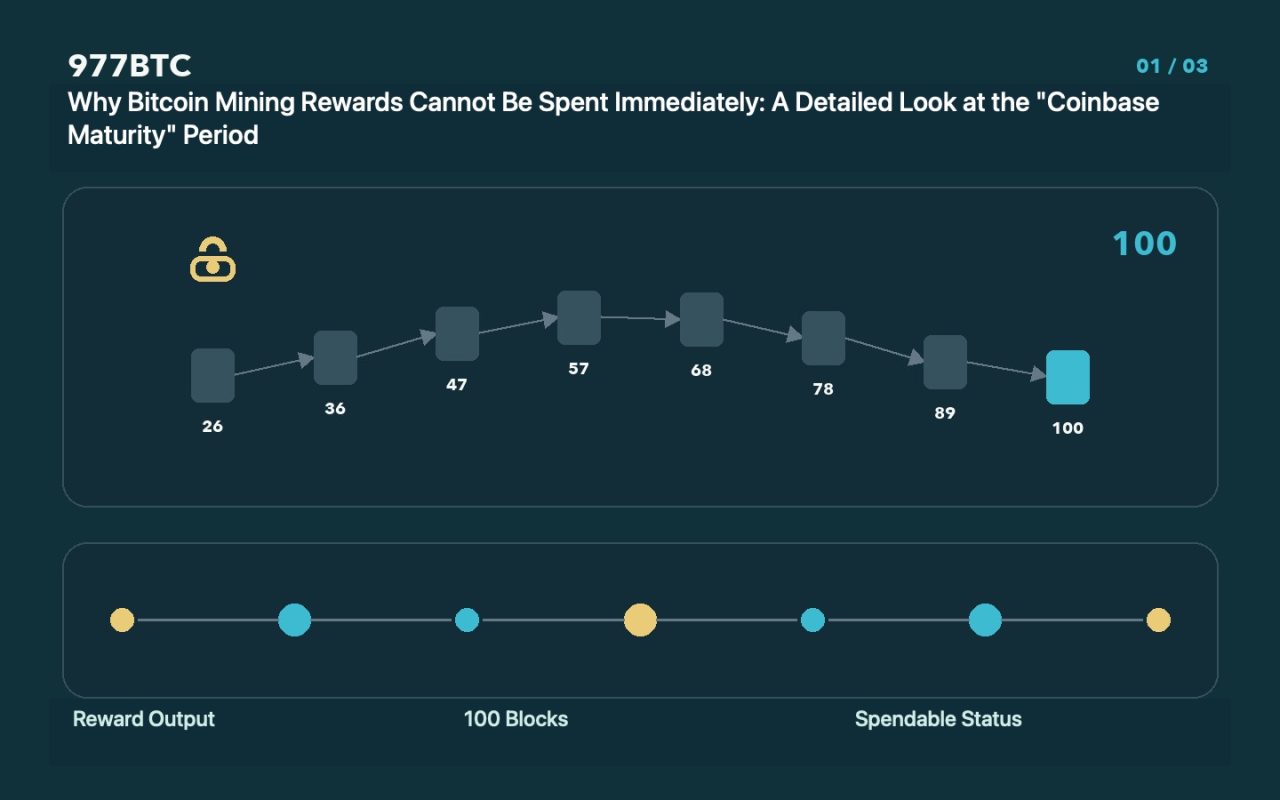
Coinbase outputs are subject to a 100-block maturity requirement. This rule restricts transactions that attempt to spend such outputs; it does not impose a waiting period on ordinary, non-coinbase transfers. Maturity is determined by block height rather than a fixed duration in hours, as the interval between blocks can fluctuate. Furthermore, the "number of confirmations" displayed by a block explorer may include the block in which the reward was generated; however, wallets and nodes determine spendability based on the current state of the blockchain.
Tracking via Block Height, Not a Countdown
Let H be the block height where the reward was generated, and T be the current "tip" (latest block) of the chain at the time of your query. Record both these heights along with the time of the query, and then check how your node or wallet evaluates the maturity of the reward output. Do not rely solely on a screenshot showing "one day remaining"—if the chain tip shifts, a network error occurs, or the original block is reorganized (orphaned), the countdown loses its validity. Distinguishing between the 100-block maturity requirement and the "number of confirmations" displayed in a user interface makes it much easier to understand why different block explorers might show conflicting information.
Mining pool payouts are a separate layer of arrangements.
Mining pools typically settle with participants according to their own distribution policies. Users may receive payments via transactions originating from a pool’s general address, rather than by directly claiming a specific coinbase output. Payout thresholds, settlement cycles, service fees, and risks regarding unpaid balances are governed by the pool’s terms; the maturation of an on-chain reward does not guarantee that the pool will issue a payout at that exact moment. It is advisable to separately track pool settlement statements, payment transaction identifiers (TXIDs), and the specific outputs received.
How to troubleshoot unavailable rewards
First, verify whether your block explorer is connected to the mainnet or a testnet, then cross-reference the block hash and output index against the current block height. Next, check if your wallet has finished synchronizing, ensure that you haven't imported only a watch-only address, and confirm that the output has not already been spent. Do not be misled by a "mature" or "immature" status indicator into purchasing "acceleration services" from unknown customer support agents; paying extra fees cannot bypass this consensus requirement, and there is never a need to provide your private keys to resolve such restrictions.
A checklist for verifying rewards
Create a table that includes the network, block hash, block height, transaction identifier (TXID), output index, amount, the current chain tip, and the maturation status. If the rewards originate from a mining pool, include the settlement batch and a link to the pool’s payout policy. When a maturation status changes, retain both the previous and updated records rather than overwriting your history. This text explains technical rules; it does not estimate mining profitability, nor can the quantity of rewards be used to infer the solvency of a miner or a mining pool.